What Really Happens to Your Tattoos When You Take a GLP-1 Weight Loss Drug
GLP-1 drugs like Ozempic can shrink your body fast, and your tattoos are along for the ride. Here is the strange biology of what really happens to your ink when the canvas beneath it changes.
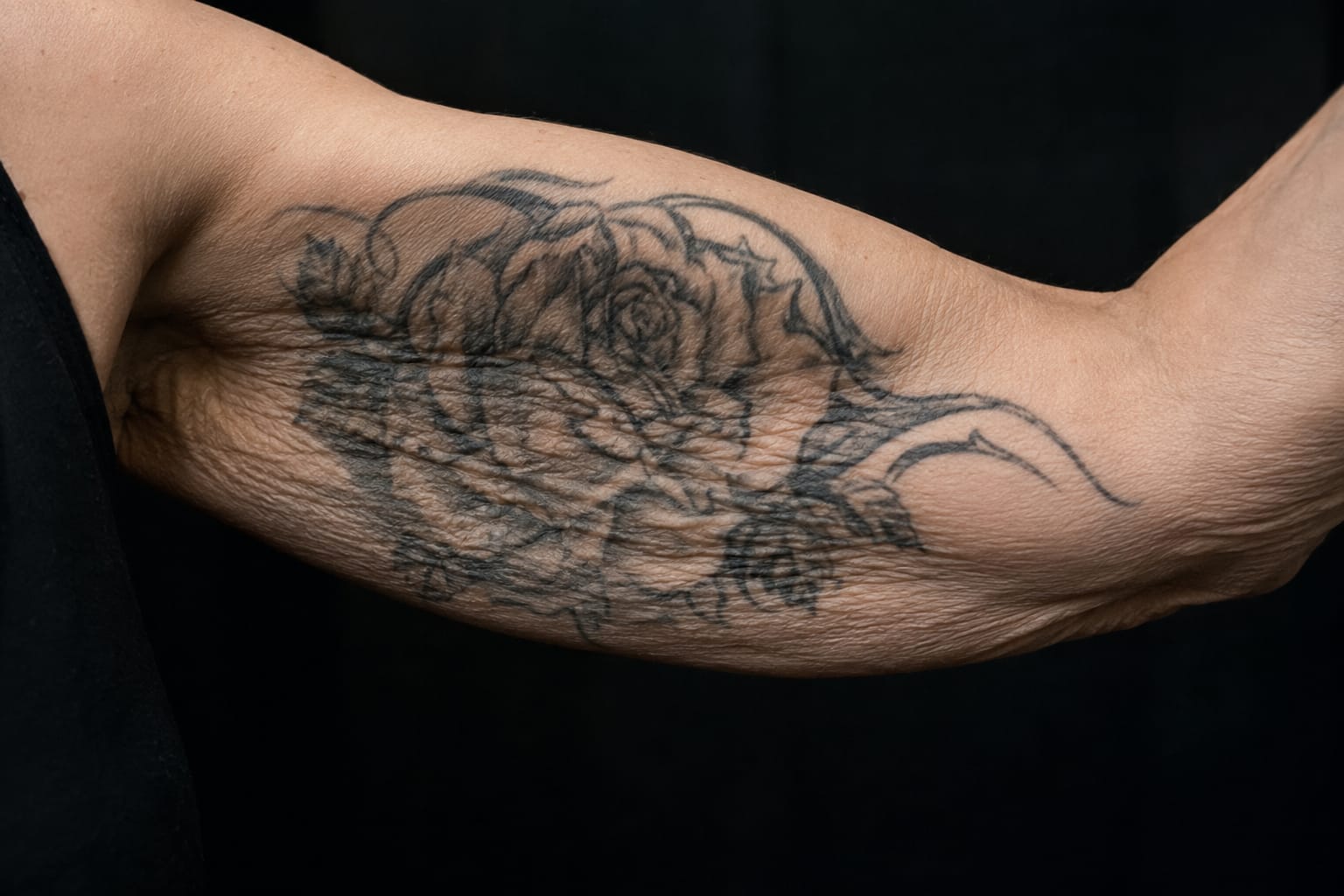
Your tattoos are not floating on top of your skin like stickers on a laptop. They are buried. Locked. Trapped in the deep architecture of your body, held hostage by cells that were never supposed to keep them.
And when you lose a dramatic amount of weight on a GLP-1 drug like semaglutide or tirzepatide, those trapped tattoos can suddenly find themselves living in a very different neighborhood.
This is the part nobody warns you about at the pharmacy counter. 💉
First, Where Your Tattoo Actually Lives
When a tattoo needle punches into your arm, it is not decorating the surface. It is stabbing past the top layer of skin, the epidermis, and delivering ink into the layer beneath it, the dermis.
Why the dermis? Because it is stable. The epidermis constantly sheds and regrows, which is exactly why a Sharpie doodle washes off in the shower but a tattoo does not.
Here is the strange, almost poetic truth of it:
Your immune system spends your entire life trying to remove your tattoo, and failing beautifully.
When ink arrives, your body treats it like an invader. Immune cells called macrophages rush in and swallow the pigment particles, trying to haul them away. But the particles are too big. So the macrophage just sits there, holding the ink, until it eventually dies and dumps the pigment out, where a fresh macrophage gobbles it right back up.
That cycle repeats for decades. Your rose, your ex's name, your questionable tribal armband from spring break, all of it is being cradled by an endless relay of exhausted immune cells. It is one of the most oddly touching facts in all of human biology.
Now Bring in the GLP-1 Drugs
GLP-1 medications work by mimicking a gut hormone that tells your brain you are full. Appetite quiets. Cravings shrink. People often lose weight fast, and sometimes a lot of it.
But here is what matters for your ink: when fat cells shrink, the skin stretched over them does not always shrink at the same speed. 📉
Skin is elastic, but it is not magic. It stretched to accommodate your body over months or years, and it does not automatically snap back into a smaller shape when the volume underneath disappears rapidly.
So the canvas changes. And when the canvas changes, the painting changes with it.
What This Does to the Actual Tattoo
Think of a tattoo drawn onto an inflated balloon. Now let some air out. The image does not vanish. It sags, wrinkles, and loses its crisp edges.
That is roughly what can happen to a tattoo sitting on skin that suddenly has less to hold onto.
People report a handful of changes, and they tend to show up together:
- Distortion: Straight lines start to curve. Round shapes go lopsided. A perfect circle becomes a sad oval.
- Blurring: Fine detail smudges as the ink-holding skin loosens and folds.
- Wrinkling: Loose skin creates creases that cut right through the design.
- Fading: As skin drapes differently, colors can look duller and less saturated.
The tattoos most at risk are the ones on areas that store the most fat and lose it the fastest. Stomachs. Upper arms. Thighs. A crisp piece on your forearm, where there is less fat to begin with, is far more likely to survive the journey intact.
An Important Reality Check
Before anyone panics and starts stroking their sleeve tattoo like a beloved pet, here is some perspective.
This is not the ink dissolving. Your tattoo is not leaking out of your body. The pigment is exactly where it has always been. It is the skin around it that moved.
That distinction matters. Because it means the fate of your tattoo depends far less on the drug itself and far more on how your particular skin responds to shrinking, which is deeply, frustratingly individual.
Age plays a role. Genetics play a role. How much weight you lose plays a huge role. How fast you lose it plays an even bigger one. A 25 year old who drops twenty pounds slowly will have a very different experience from a 55 year old who drops eighty pounds in half a year.
The Question Nobody Wants to Ask Their Tattoo Artist
Then there is the other half of the story: getting a new tattoo while on a GLP-1 drug.
Here the picture gets murkier, and honesty demands admitting how much we simply do not know yet. These medications exploded into mainstream use faster than the research could chase them. 🏃
What tattoo artists have started whispering about is timing. Getting inked on skin that is actively shrinking is a bit like framing a photo while the wall is still being painted. If your body is mid-transformation, the fresh tattoo is being placed on a moving target.
The smarter play, according to a lot of artists, is patience. Let the weight stabilize. Let the skin settle into its new shape. Then decorate the finished canvas rather than the one still under construction.
Healing Is Its Own Wild Card
There is another layer worth sitting with. GLP-1 drugs change how your body handles food and, by extension, nutrition. And healing a tattoo is a genuinely demanding biological task.
Your skin has to repair a few thousand tiny puncture wounds while simultaneously deciding which ink stays and which gets carried off. That process runs on protein, on nutrients, on a body that has enough fuel to do repair work.
When appetite drops sharply, some people simply eat less of everything, including the building blocks their skin needs to heal cleanly. Nobody is claiming a granola bar ruins a tattoo. But a body running on fumes is not a body doing its best repair work, and fresh tattoos are unforgiving of a sluggish healing process.
So What Should You Actually Do
The temptation is to treat this like a warning sign flashing DO NOT GET TATTOOS. That is the wrong takeaway.
The right one is quieter and more useful:
Your skin is a living, changing thing, and a tattoo is a promise you make to a body that refuses to stay the same.
If you already have tattoos and you are starting a GLP-1 journey, the ink is not doomed. Some tattoos come through completely fine. Others soften a little. A few get genuinely distorted, and those can often be revived later with a touch up or a rework once your weight has settled.
If you are planning a new tattoo, the boring advice is also the best advice. Talk to your doctor. Talk to your artist. Wait until the scale has stopped moving before you commit permanent art to temporary proportions.
The Strangely Human Heart of It
There is something almost tender buried in this whole mess. We get tattoos to freeze a moment, to make something about ourselves permanent. And then our bodies, relentless and alive, keep changing underneath the ink anyway.
The macrophages keep passing the pigment hand to hand. The skin keeps stretching and shrinking with the tides of our lives. A tattoo is not a photograph pinned to a wall. It is a living thing carried by a living thing, and both of you are aging together.
The medication just speeds up a conversation your skin and your ink were always going to have. And maybe that is the most honest thing a tattoo can do: not stay perfect, but stay with you, through every version of the body you happen to be wearing at the time.