The Sickening Truth: How the Food and Drug Industries Feed You Sick and Sell You the Cure
One industry engineers food that makes you sick. Another sells the cure. And sometimes the same investors own both. Here is how your declining health became the most reliable business model ever invented.
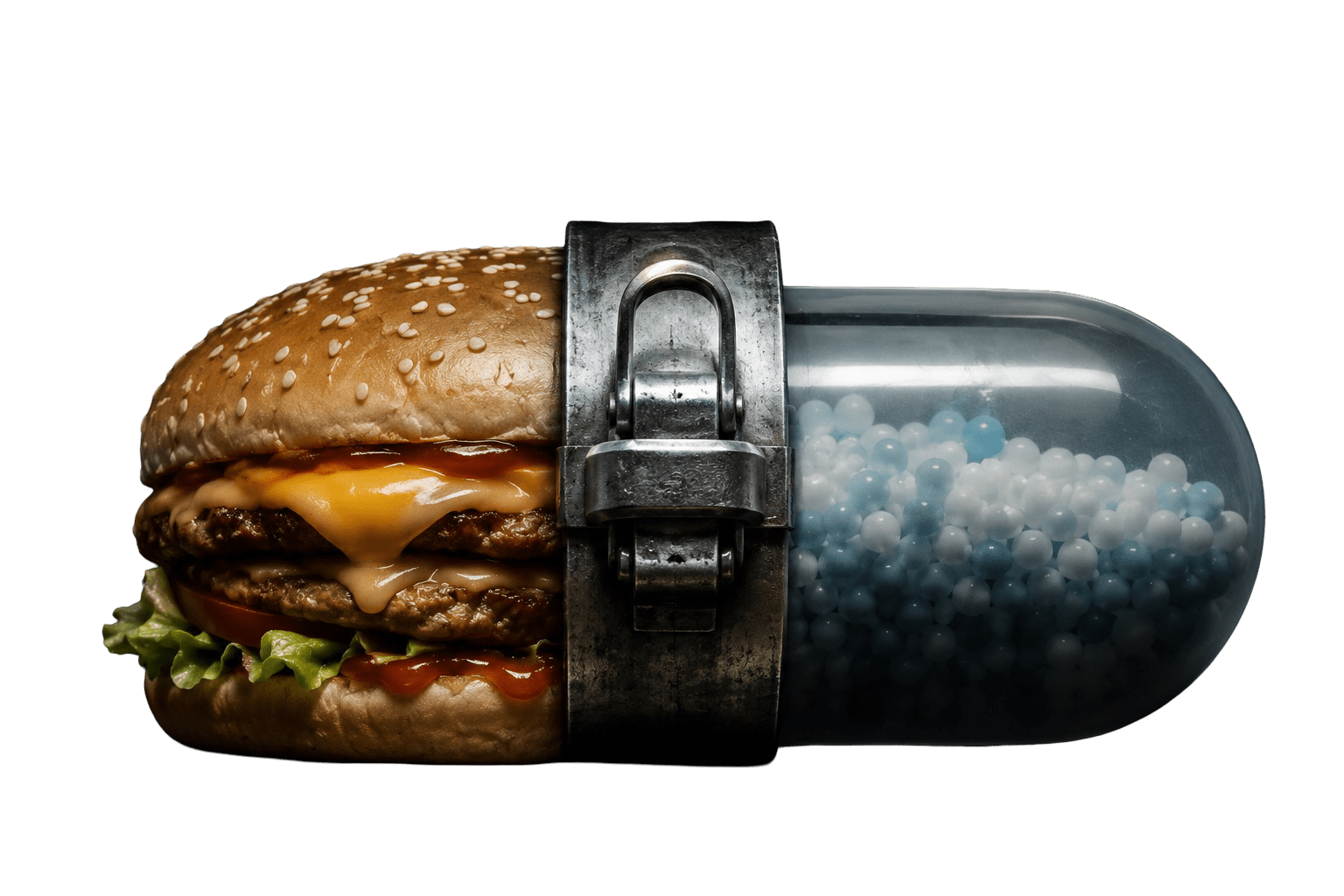
Somewhere in a boardroom right now, a company is celebrating the fact that you are getting fatter, sicker, and more anxious. And they have every reason to cheer, because your declining health is the single most reliable business model ever invented. 🎉
This is not a conspiracy whispered in the dark corners of the internet. It is a quiet, elegant, almost beautiful machine, and it hums along in plain sight while everyone pretends not to notice.
Here is the setup. One industry engineers food that is impossible to stop eating. A second industry sells the medicine to treat the diseases that food creates. And in a growing number of cases, the same investment firms own significant stakes in both. Your body is the battlefield, and both armies are on the same payroll.
The Food That Was Built to Break You
Walk down the middle aisles of any grocery store and you are surrounded by food that barely deserves the name. These are ultra-processed products, engineered in laboratories by scientists whose entire job is to find what researchers have called the bliss point, the exact ratio of sugar, salt, and fat that overrides the ancient signals your brain uses to say stop, I am full.
Think about that for a moment. Your body evolved over millions of years with a simple, life-saving instinct: eat when hungry, stop when satisfied. And a food chemist with a spreadsheet figured out how to switch that instinct off. 🧠
The result is food that feels less like nourishment and more like a slot machine you eat. One chip lights up the reward center. The reward center demands another. Before you know it the bag is empty and you are strangely, hollowly, still hungry.
These products are not accidentally addictive. They are addictive on purpose, refined and tested with the same intensity a tech company uses to keep you scrolling at two in the morning.
And the consequences are not subtle. Diets heavy in ultra-processed food are strongly linked to obesity, type 2 diabetes, heart disease, and a whole grim parade of chronic conditions. Each one of those conditions, conveniently, has a treatment.
Enter the Pharmacy, Holding a Solution and a Bill
Once the food has done its work, the second act begins. 💊
You develop high blood pressure. There is a pill for that. Your blood sugar climbs. There is a pill for that too. Your cholesterol spikes, your joints ache, your mood sinks, and for every single symptom a bright package waits on a pharmacy shelf, promising relief for a monthly fee.
Now, medicine is one of the greatest achievements of our species. Insulin has saved millions of lives. This is not an argument against treatment. It is an argument against a system that profits most when the underlying problem never gets solved.
Because here is the uncomfortable part.
A cured patient buys medicine once. A managed patient buys medicine forever.
Chronic disease is a subscription service, and business is booming.
Follow the Money, and Prepare to Be Angry
Now for the twist that turns a coincidence into something far more disturbing.
Large investment firms often hold major ownership stakes across entire industries at once. The same financial giants that own enormous shares of processed food companies frequently own enormous shares of pharmaceutical companies too. 🤝
Picture a single hand holding two puppets. One puppet sells you the sugary breakfast cereal. The other puppet sells you the diabetes medication. And no matter which one you reach for, the money flows back to the same fist.
It is the kind of arrangement that would feel too on the nose if you saw it in a movie. A villain who poisons the well and then charges admission to the hospital. Except this villain does not twirl a mustache. It files quarterly earnings reports and sends flowers to shareholders.
The Lobbying Machine Nobody Voted For
You might reasonably ask why the government does not simply step in and stop this. The answer lives in a swamp of lobbying money so vast it could make a person weep.
Both the food and pharmaceutical industries spend staggering sums influencing the very rules meant to protect the public. When nutrition guidelines are written, industry voices are in the room. When drug pricing is debated, industry lobbyists are working the halls.
The referee, it turns out, has been quietly hired by both teams.
And so the warnings stay soft. The regulations stay loose. The word natural gets slapped on products with laboratory ingredient lists longer than a receipt. And the public is left to navigate a marketplace designed to confuse them.
The Human Cost Behind the Spreadsheet
It is easy to talk about this in the cold language of markets and stakes and margins. But strip away the corporate vocabulary and what remains is deeply, achingly human.
It is a father who cannot play in the yard with his kids because his knees and his heart have given out. It is a teenager already on medication for a condition that used to appear only in middle age. It is a family choosing between groceries and prescriptions at the end of the month, trapped in a loop they never designed and cannot escape.
These are not statistics. They are the people sitting next to you on the bus, standing behind you in line, sleeping down the hall. Their bodies have become the raw material of a business, and most of them have no idea the game is even being played.
The cruelest part is the shame. People are told their sickness is a personal failure, a lack of willpower, when in truth they were outmatched by billion dollar engineering before they ever picked up a fork.
Why This Is Not Simply Hopeless
Here is where a little defiance is in order, because despair is exactly what a system like this wants from you.
The machine is powerful, but it is not invincible. Its greatest weakness is sunlight. The moment enough people understand how the pieces fit together, the whole illusion of individual blame starts to crack.
Real food, the kind that rots if you leave it out, the kind grown rather than manufactured, remains available and remains a threat to this entire model. Every meal cooked from actual ingredients is a small act of rebellion. 🥦
And pressure works. Public outrage has forced industries to change before, from tobacco warnings to seatbelt laws. There is nothing sacred about the current arrangement. It exists because it is profitable and because it is ignored. Remove the ignorance and you remove half its power.
The Question Worth Sitting With
So consider the strange world we have built. A world where one set of companies is financially rewarded for making people sick, and another set is rewarded for keeping them sick just long enough to keep paying, and both sets sometimes answer to the same owners.
It is a marvel of efficiency, honestly. A closed loop of profit with a human being at the center, feeding both ends. If it were not happening to us, it would almost be impressive.
The food is engineered. The medicine is priced. The rules are lobbied. And the outrage, the one thing that could actually shift the balance, is the only ingredient the industry cannot manufacture on its own. That part is still up to everyone reading the label a little more carefully, asking harder questions, and refusing to accept that their own body was ever supposed to be somebody else's revenue stream.