Shaquille O'Neal on GLP-1: The 400-Pound Giant Who Shrunk Himself With a Weekly Shot
Shaquille O'Neal openly revealed he lost around 40 pounds using a GLP-1 medication. His shrinking transformation exposes the awe, the risks, and the ugly access gap behind the most talked-about drug in modern medicine.
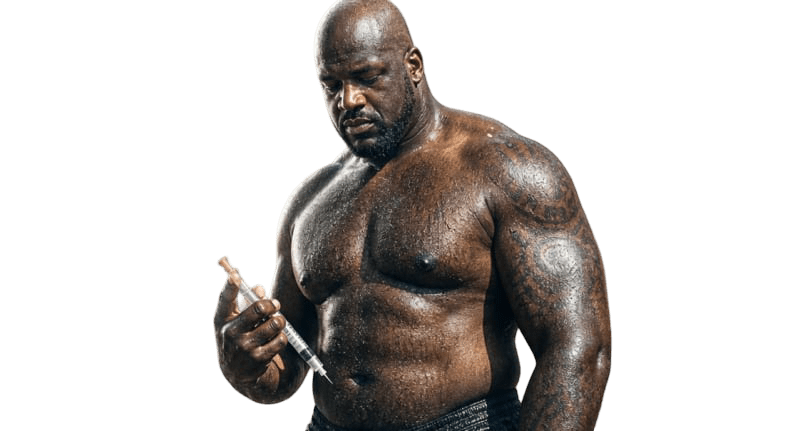
A man who once weighed more than a vending machine willingly injected himself with a drug designed for diabetics, and the result was a body that shed pounds like a snake shedding skin. 💉
That man is Shaquille O'Neal, the four-time NBA champion whose feet are so large they require custom manufacturing, and whose recent transformation has become one of the most public experiments in modern pharmacology.
He didn't whisper about it. He announced it on a podcast, grinning, telling the world he had lost around 40 pounds and felt like a new person. And in doing so, he became an accidental spokesman for a class of drugs that has quietly rewritten what human hunger even means.
The Body That Defied Physics
Consider, for a moment, the machine that is Shaquille O'Neal. 🏀
At his playing peak he stood over seven feet tall and carried more than 300 pounds of muscle capable of tearing down entire backboards. After retirement, the weight kept climbing. By his own admission, he crossed 400 pounds, a number so large it makes ordinary bathroom scales surrender.
Here was a body that had spent decades performing miracles, dunking with the force of a small car, and yet it was slowly becoming a liability. Big men, cardiologists will tell you, carry big risks. The heart that pumps blood through a frame that size works overtime, every hour, every day, for a lifetime.
The tragedy of the very large athlete is that the same body that made them legendary is often the one that betrays them first.
So when O'Neal decided to change, he reached for something new. Not a fad diet. Not a boot camp. A molecule.
What Actually Happens Inside a GLP-1 Shot
GLP-1 stands for glucagon-like peptide-1, which sounds like the name of a robot from a low-budget science fiction film. 🤖
In reality it is a hormone your gut naturally produces after you eat. It is a tiny chemical messenger, and its job is deceptively simple. It tells your brain that you are full. It slows the emptying of your stomach. It nudges your pancreas to release insulin at the right moment.
Drugs like semaglutide, sold under names such as Ozempic and Wegovy, are synthetic mimics of this hormone. They are, in essence, a forgery of your body's own satisfaction signal, and a remarkably convincing one.
Here is the strange and beautiful part. The people taking these drugs often describe something eerie. The constant background noise of hunger, the internal voice that whispers about snacks and second helpings, simply goes quiet.
Scientists have a phrase for that mental chatter about food. They call it food noise. And for millions of people, these injections have turned the volume all the way down.
The Giant Becomes an Advertisement He Never Signed Up For
When a man as famous and as physically iconic as Shaquille O'Neal admits he is on one of these drugs, something cultural shifts. 📢
For years, weight loss medication carried a whiff of shame, as if choosing science over suffering was somehow cheating. O'Neal blew that idea apart with a single casual conversation.
He framed it plainly. He wanted to be healthy. He wanted to look good. He is a grandfather-aged man who still wants to move through the world with ease. And he decided a weekly injection was a reasonable tool to get there.
There is a quiet revolution in a celebrity saying out loud that willpower alone was never the whole story.
To be fair, O'Neal has also emphasized that he pairs the medication with exercise and a trainer. This matters enormously, and we will return to it, because the shot is not a magic wand no matter how the internet tries to sell it as one.
The Awe and the Asterisk
The awe is real. These drugs represent one of the most significant advances in metabolic medicine in a generation. People with type 2 diabetes see their blood sugar stabilize. People with dangerous obesity see their heart risks fall. Early research even hints at benefits for the heart, the kidneys, and possibly the brain. 🧠
But awe without skepticism is just marketing.
So here is the asterisk. These medications are not free of consequences, and anyone treating them like candy is playing a game they do not fully understand.
The known side effects include a menu of gut misery. Nausea. Vomiting. Diarrhea. Constipation. For some people the discomfort is mild and fades. For others it is a daily negotiation with their own stomach.
There is also the matter of what disappears along with the fat. When people lose weight rapidly, they lose muscle too, not just the soft padding around the waist. For an aging athlete, preserving muscle is not vanity. It is survival. It is the difference between standing up easily at 70 and struggling to.
This is precisely why O'Neal's insistence on training alongside the drug is the smartest part of his entire strategy. The injection quiets his appetite. The gym protects the machinery underneath.
The Uncomfortable Question of Access
Now for the part nobody in a glossy commercial wants to discuss. 💰
Shaquille O'Neal can afford anything. His net worth is enormous, built from basketball, endorsements, and a business empire that includes restaurants and a mountain of investments.
When these drugs cost hundreds of dollars a month without insurance coverage, they become a story about money as much as medicine. A billionaire's weekly shot is a rounding error. For a working parent with the same health struggles, it can be an impossible expense.
The result is a peculiar and unfair landscape.
- The wealthy access a life-changing medication with ease.
- The people who may need it most, those with fewer resources and higher health risks, often stand outside the pharmacy window empty-handed.
When a treatment this powerful exists but is rationed by wealth, we are not really talking about biology anymore. We are talking about who a society decides is worth saving.
What the Shrinking Giant Really Teaches Us
The image is unforgettable. A man built like a mythological titan, someone whose entire brand was overwhelming physical bigness, choosing to become smaller on purpose. 🏆
There is a lesson buried in Shaquille O'Neal's needle, and it is not the one the headlines chase.
The lesson is that hunger was never a simple failure of character. It is a symphony of hormones, neurons, and evolutionary wiring that kept our ancestors alive through famine. For most of human history, an appetite that never quit was a gift. In a world of endless cheap calories, that same gift became a burden.
These drugs work because they intervene in that ancient biology directly. They do not lecture you about discipline. They rewire the signal itself.
For the first time, medicine can whisper to the body in the body's own language, telling it that it has had enough.
O'Neal's story is a single data point wrapped in celebrity glamour. But behind him stand millions of ordinary people quietly injecting the same molecules, hoping for the same quiet in their heads.
Some will find relief that changes their lives. Some will battle side effects that make them quit. Some will regain the weight the moment they stop, because these drugs are often a lifelong commitment rather than a temporary fix.
The giant got smaller, and the world watched. What the world should really be asking is not how much weight he lost, but why we spent so long believing the problem lived in people's willpower instead of their biology, and who gets left behind now that a real answer finally exists.