Serena Williams and GLP-1: Inside the Champion's Bold Bet on Her Own Biology
Serena Williams openly using a GLP-1 medication sparked outrage, but the real story is what these drugs do inside the body and why our shame around them helps no one.
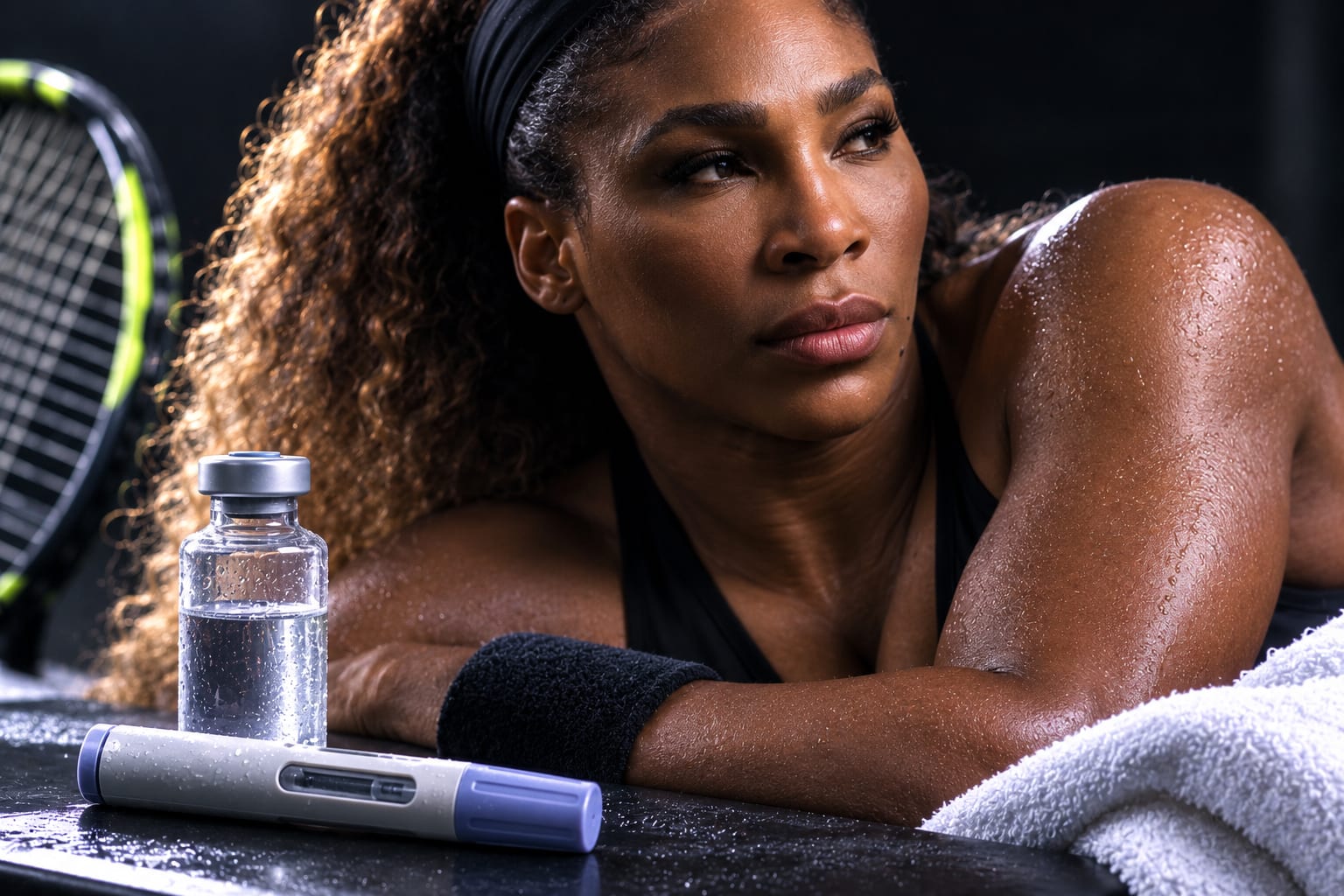
Serena Williams, the woman who spent two decades turning tennis courts into battlegrounds where physics itself seemed to bend around her serve, has decided to talk about a drug. Not a performance enhancer. Not a scandal. A weight-loss medication called a GLP-1, the same class of drugs that has turned pharmacies into modern gold rushes and dinner parties into whispered confessionals.
And here is the shocking part: she is not embarrassed. 😮
In a culture that treats a woman admitting she used medical help for her body as a crime somewhere between vanity and betrayal, Williams walked directly into the fire and announced she was using one. The internet did what the internet does. It exploded, it moralized, it demanded she return to some imaginary purity test that no one asked the rest of us to pass.
But to understand why this matters, you have to understand what is actually happening inside a body when a GLP-1 goes to work. It is genuinely strange. It is genuinely beautiful. And it is genuinely being misunderstood by roughly everyone with a keyboard.
What Is Actually Happening Inside Her Body 🧬
GLP-1 stands for glucagon-like peptide-1. Your gut already makes it. Every time you eat, cells lining your intestine release tiny chemical messengers that fan out through your bloodstream like town criers, shouting a single instruction to your brain and pancreas: we have food, calm down.
The medications mimic that natural signal, except they linger. They refuse to leave. They keep whispering that message of fullness long after a normal hormone would have faded into silence.
Think of it less as a diet drug and more as a translator, one that finally lets your gut and your brain speak the same language after years of talking past each other.
For someone like Williams, whose body was engineered by relentless training into a machine of explosive power, pregnancy and childbirth rewrote the rules. Twice. She has been openly honest that her second pregnancy nearly killed her, that her body has fought battles most fans never saw behind the trophies.
So when a champion decides to use a tool that speaks directly to her own biology, the question worth asking is not why would she cheat? The question is why do we still treat medicine for the body as shameful when we celebrate it for everything else?
The Absurd Double Standard 🎾
Here is a genuinely funny thing about our collective brain. We hand out standing ovations to athletes who fix their knees with surgery, who inject their joints, who sleep in oxygen tents and eat measured grams of protein weighed on scales more precise than a jeweler's. We call that discipline.
But a woman takes a weekly injection that adjusts a hormone signal, and suddenly the pitchforks come out.
The logic collapses the moment you poke it. Nobody accuses a person with poor eyesight of cheating for wearing glasses. Nobody demands a diabetic feel ashamed of insulin. Yet weight, especially a woman's weight, remains the last territory where we insist suffering is the only honorable path.
That belief is not science. It is superstition wearing a lab coat.
The Part Where We Slow Down and Get Honest 🩺
Now, radical honesty demands the other side of the ledger, because awe without skepticism is just a commercial.
These drugs are not candy. They come with real trade-offs that get buried under the celebrity glow.
Some people feel nauseated for weeks. Some lose muscle along with fat, which for an athlete is a genuine concern, not a footnote. Some experience their relationship with food shifting so completely that eating stops feeling like joy and starts feeling like a chore. And the long game, what happens across decades of use, is still being written in real time inside the bodies of millions of people who signed up as unwitting participants.
The uncomfortable truth is that we are running the largest uncontrolled experiment on human appetite in history, and most of the volunteers found out about it from a friend at brunch.
There is also the money. My goodness, the money. 💸
The companies making these drugs are printing profits at a scale that makes oil barons look modest. When something becomes that lucrative, the pressure to smooth over risks and amplify miracles becomes almost gravitational. A celebrity endorsement, even an honest one, becomes a marketing asset worth more than any billboard.
Why Serena Talking Matters Anyway ⭐
And yet.
Despite the caveats, despite the corporate machinery churning behind the curtain, there is something quietly radical about the most decorated tennis player of her generation refusing to lie about her body.
For years, women in the public eye have performed an exhausting theater. They credited green juice and yoga and good genes for transformations that had far more complicated explanations. They protected a fantasy that made ordinary women feel like failures for not achieving the impossible on willpower alone.
Williams cracked that theater open.
She essentially said: this is a real thing, real people use it, and pretending otherwise helps no one. That is not an advertisement. That is a woman handing the rest of us a permission slip to stop lying to ourselves and our doctors.
The shame around these medications does not protect anyone. It just makes people take them in secret, without guidance, without honesty, without the support they deserve.
The Bigger Picture Nobody Wants to Sit With 🌍
Zoom out far enough and this story stops being about one athlete and one injection. It becomes a story about a species that built a world overflowing with engineered food designed to override the exact signals these drugs restore.
We flooded the environment with cheap calories engineered by scientists to hijack the reward centers of the brain. Then we blamed individuals for lacking the discipline to resist a system built by teams of people whose entire job was defeating human willpower.
GLP-1 drugs are, in a strange way, a mirror. They show us that appetite was never purely a matter of character. It was always chemistry, biology, and a food landscape rigged against the very hormones now being sold back to us in a syringe.
There is a bitter irony there, and it deserves to be named.
What Her Choice Really Reveals 💪
Serena Williams does not need anyone's approval. She has more championship titles than most players dare to dream of, a business empire, and a legacy carved into the history of the sport in permanent ink.
So when she chose to speak plainly, she was not asking for validation. She was spending some of her enormous cultural capital on an unglamorous truth.
She turned her own body into a teaching moment, the way she once turned her serve into a lesson in what human limits could actually be.
The woman who spent her career proving that power and grace were never opposites has now suggested the same about medicine and honesty. You can use a tool. You can respect its risks. You can refuse to be ashamed. All at once.
The crowd that wants to reduce her to a cautionary tale has fundamentally misread the assignment. Because the most dangerous thing Serena Williams ever did was not taking a drug.
It was telling the truth about it out loud, in a world that would have preferred she stay quiet and let everyone keep pretending. 🎤